A single defect in a deployed medical device is never “just a patch.” It can mean a field recall, an adverse event report, or a delayed submission that costs a program months. That's the reality medical device teams are building in today, and it's exactly why compliance can't be treated as a finish-line activity. The teams that fare best treat it as something built in from day one, not something chased after the fact.
Here’s what that looks like in practice, and why it matters more than ever.
The compliance bottleneck is structural, not a maturity problem
Medical software programs rarely stall because the engineering is immature. They stall because compliance is still treated as a final gate. IEC 62304 tool qualification done in-house adds months to every certification cycle and it repeats with every release. Meanwhile MDR, FDA requirements, IEC 81001-5-1, and the EU Cyber Resilience Act (CRA) all converge on the same piece of software, so teams end up duplicating compliance work instead of sharing evidence across it.
IEC 62304 doesn’t sit in isolation either. It’s part of a broader standards landscape: ISO 14971 for risk management and ISO 13485 for quality management set the direction for evaluating a safe device, while product standards and IEC 81001-5-1 shape implementation. All of it converges on one place, the actual implementation of the medical device software, which is exactly where a toolchain decision either helps or hurts.
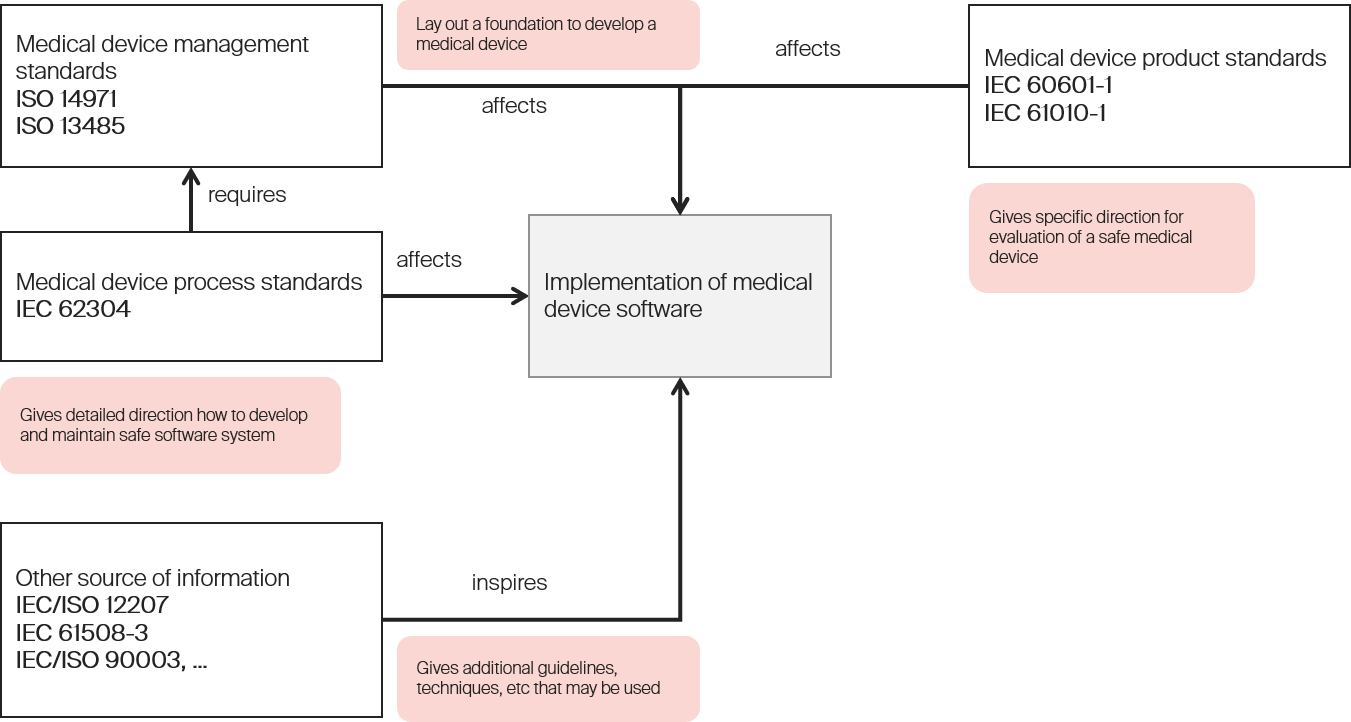
Image: How IEC 62304 fits within the broader medical device standards landscape.
Three patterns show up in almost every program
Across implantables, wearables, imaging, surgical robotics, and connected hospital systems, the same friction keeps appearing:
-
Fragmented toolchains: Every MCU vendor change means restarting qualification, with compilers, linkers, and analysis tools revalidated from scratch.
-
Manual IEC 62304 qualification: Done in-house, it adds months to every release cycle, and it repeats with every new MCU or toolchain update.
-
Decade-long lifecycle pressure: Devices shipping today need to run certified, maintainable code 10, 15, even 20 years from now, which means the toolchain itself has to still exist, still be supported, and still produce a valid compliance case that far out.
-
~20–30% smaller code size: In wearables, right-sizing the MCU and extending battery life
-
50% faster CI/CD build times: Using containerized, safety-certified workflows with automated evidence generation
-
80% less debugging effort: With multi-core trace, Power Debugging, and RTOS-aware views
-
Up to 12 months eliminated: From validation time by moving from in-house IEC 62304 qualification to a pre-certified toolchain
Shifting compliance left for IEC 62304 and CRA
The fix isn’t more process, it’s decoupling certification from silicon choice. Consolidating IEC 62304 qualification into one pre-certified toolchain that spans MCU and MPU families means switching vendors no longer means restarting qualification. Mixed safety-class systems and multiple architectures converge under one IDE, one debugger, and one set of compliance evidence — one audit trail instead of five.
Reproducibility is the engine behind this. Containerized toolchain versions guarantee identical builds across every developer machine, CI server, and cloud pipeline, eliminating the classic “it built on my machine” qualification failure. Automated MISRA C/C++, CERT C/C++, and CWE analysis run in every CI cycle rather than at the end of the project, catching defects when they cost hours to fix, not months. And Long-Term Support (LTS) preserves toolchains, build environments, and compliance evidence across a 10+ year device lifecycle, which is also what makes the CRA’s sustained maintenance requirement achievable rather than aspirational.
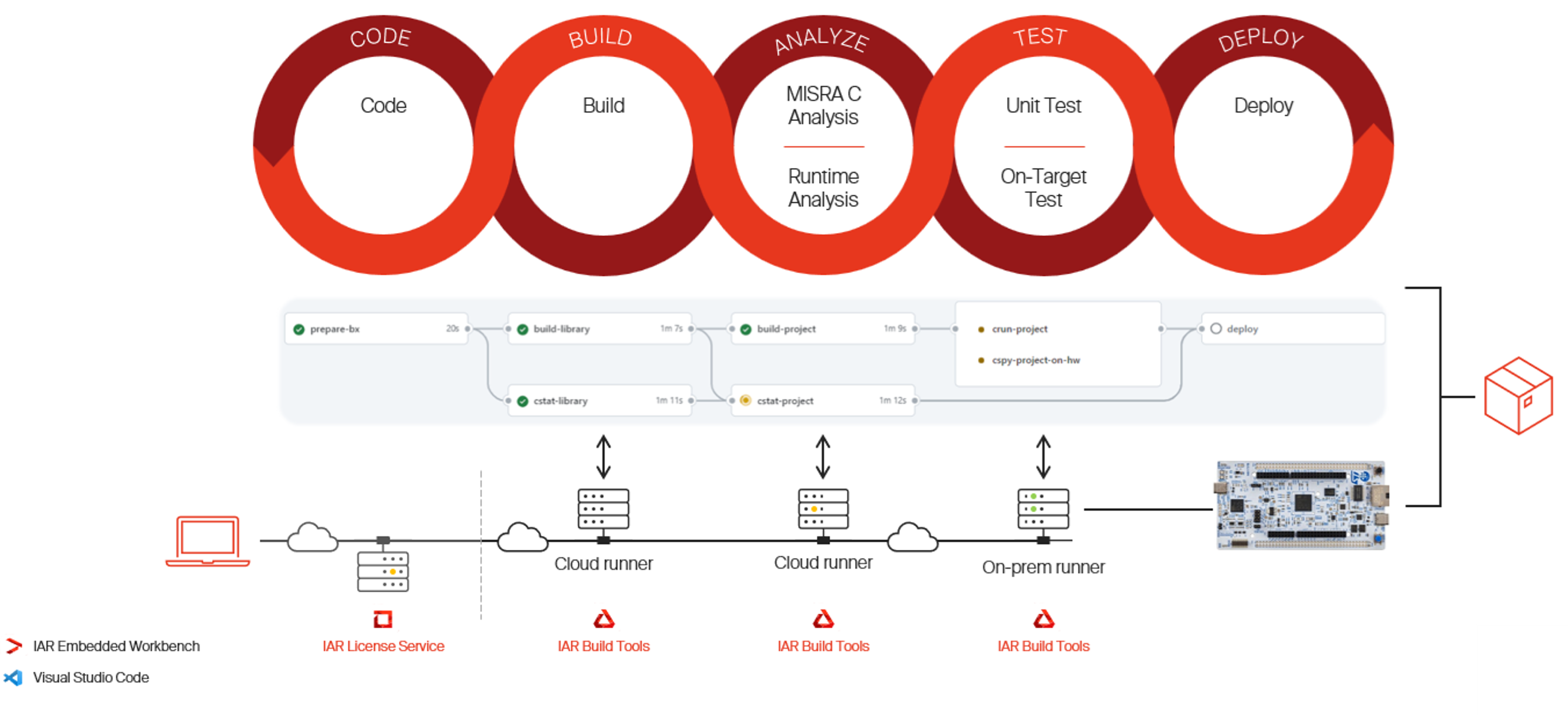
Image: The same certified toolchain runs code → build → analyze → test → deploy, from laptop to cloud runner to on-prem runner to target hardware.
What this delivers in practice
IAR’s platform is one toolchain, one qualification, covering 20+ architectures: Arm, RISC-V, Renesas RX/RL78/RA, and STM8 among them and it’s TÜV SÜD-certified for IEC 62304 up to Class C. That combination of commercial support, safety certification, and vendor-agnostic coverage is what separates it from a vendor-native toolchain that locks you into one silicon family, or an open-source option with no certification and no long-term support commitment.
In real programs, that translates to measurable outcomes:
Teams building on IAR aren’t standing this up in isolation, either. The platform integrates with the CI/CD systems already in most pipeline: Kubernetes, Jenkins, GitLab, GitHub plus VS Code, Eclipse, and container workflows for embedded DevSecOps. Unit and module testing runs through Qt's Coco, Axivion, VectorCAST, QA Systems, and Parasoft. Connectivity is covered for Bluetooth LE, Wi-Fi, and cellular, aligned with IEC 81001-5-1 and CRA cybersecurity expectations, and RTOS support spans Zephyr, FreeRTOS, SCIOPTA, Wittenstein, and others for medical-grade real-time control.
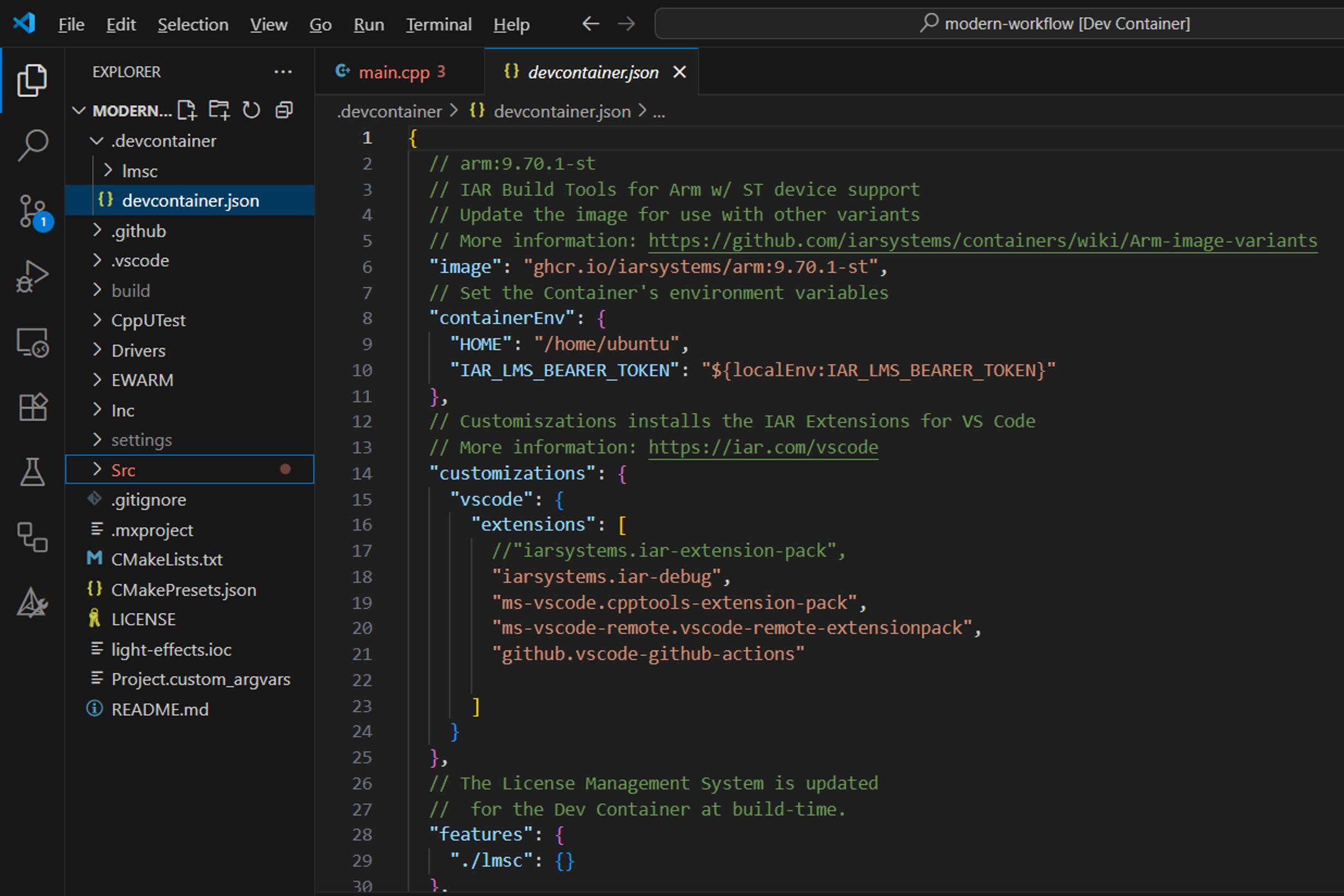
Image: The dev container configuration, same containerized IAR Build Tools and VS Code extensions for every developer, no manual setup.
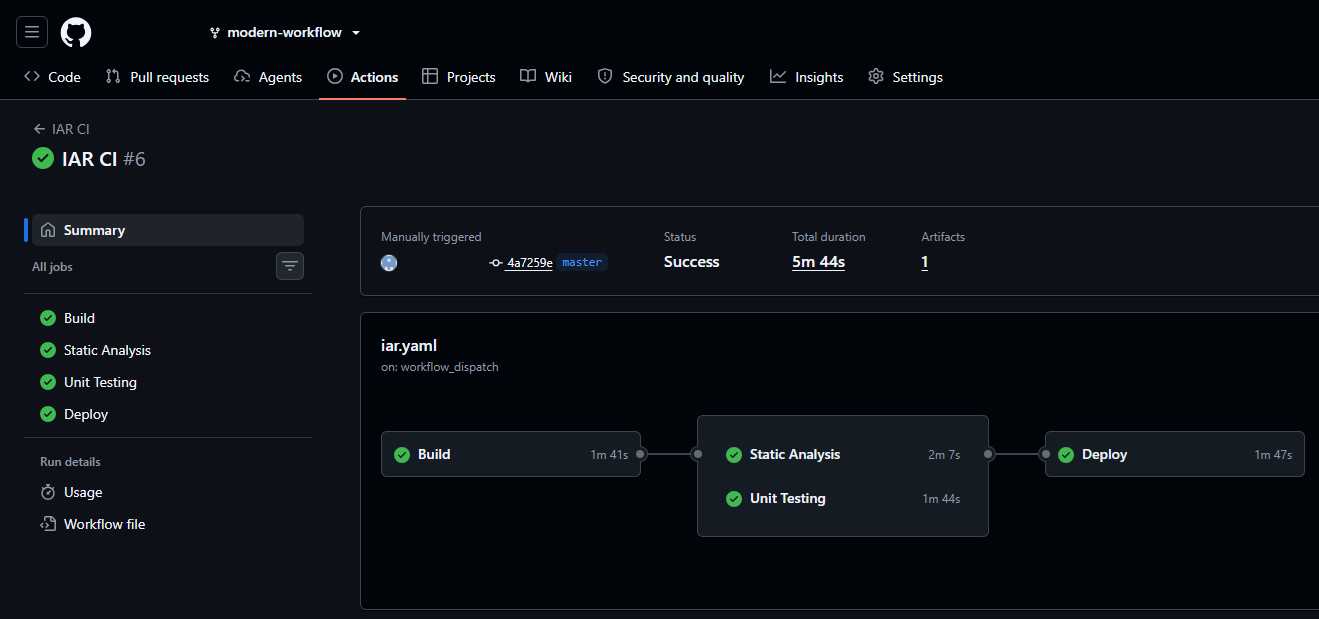
Image: The same pipeline in action: build, static analysis, and unit testing running in GitHub Actions on every commit.
Real programs, real outcomes
APEXBIO, a biosensor company shipping FDA- and CE-approved glucose, ketone, cholesterol, and HbA1c monitoring systems in over 80 countries, has used IAR since 2004 and estimates 10–30% shorter development time. Osong Medical Innovation Foundation (KBIO) used IAR to shrink code size for device miniaturization and applied Power Debugging to optimize current consumption in wearables, with build times running at least twice as fast as alternatives. And Sunrise Labs, an ISO 13485-certified contract developer, uses IAR to specify, verify, and generate code for complex device behaviors keeping designs clear across clients, developers, and risk management teams.
What's next? See it for yourself
Compliance doesn’t have to be the bottleneck it’s been. A pre-certified, vendor-agnostic foundation that qualifies once and stays supported for the life of your product turns fragmented certification and decade-long lifecycle pressure into a solved problem instead of a recurring one.
Explore how IAR’s safety-certified toolchains support life-critical control, secure connectivity, and long-lifecycle development on our medical technology solutions page, or try the interactive medical device demo to see how quality, safety, and compliance move left across the medical software lifecycl, build medical devices patients can rely on.