Functional safety, Code quality, Embedded DevOps, Industrial Automation, MedTech
Software-defined everything in embedded systems: Staying in control as complexity grows
- By Shawn Prestridge
- 9 min read
Embedded systems have always been software-driven. For decades, engineers have used software to differentiate products, improve performance, and extend functionality beyond what fixed hardware alone could offer.
What has changed is not the idea itself, but the scale and complexity.
Today, more functionality is delivered in software than ever before. Features, performance tuning, connectivity, security behavior, and lifecycle management are increasingly handled through software updates rather than hardware redesigns. This shift is often described as Software-Defined Everything (SDx).
The concept is well known from software-defined vehicles (SDVs), but the same pattern is now evident across industrial automation, IoT, energy systems, and medical technology.
For embedded teams, this is not a radical break from the past. IAR has been helping companies develop embedded software for more than 40 years, and many of the underlying principles remain the same. What has changed is that:
-
Systems are more connected
-
The need for updates over long lifecycles has increased dramatically
-
Security requirements are higher
-
Software must evolve safely after deployment
As a result, software now carries more responsibility and more risk.
While software plays a larger role, embedded systems remain constrained, real-time, and often safety-critical. This means that flexibility alone is not enough. Control, predictability, and long-term stability matter more than ever.
This is the context in which Software-Defined Everything becomes relevant for embedded systems, not as a buzzword, but as a practical challenge that must be managed carefully.
What software-defined everything mean in an embedded context
In embedded systems, SDx does not mean removing hardware from the equation. Instead, it means decoupling system functionality from specific hardware implementations, allowing products to evolve primarily through software over their lifetime.
At its core, SDx in embedded systems is built on a few key principles.
A software layer abstracts system capabilities and dataflows, rather than exposing raw hardware resources such as specific peripherals or interfaces. This abstraction allows application software to describe what the system should do and how data should be processed, without being tightly coupled to how that data is acquired, transported, or generated. As a result, developers can focus on application behavior and system intent rather than low‑level implementation details, while still meeting strict real‑time, performance, and reliability requirements.
This separation between application logic and implementation details is also what makes long-lived systems manageable as complexity grows. When software is structured around stable system behavior rather than hardware specifics, evolution becomes controlled rather than fragile.
Portability follows naturally from this approach. When software is designed to outlive a single processor or device generation, teams gain resilience against supply‑chain disruptions and reduced dependence on any specific vendor. In practice, this means software architectures that can survive processor or platform changes without being rewritten, preserving both engineering investment and validated system behavior across hardware transitions.
How SDx is transforming embedded industries
Software-defined vehicles
In automotive systems, SDV has become a defining concept. Vehicle differentiation increasingly comes from software: driver assistance, connectivity, user experience, and post-sale feature activation.
At the same time, SDV relies on deeply embedded controllers that must remain deterministic, safe, and predictable for more than a decade. Here, software-defined innovation only works if the build and update processes themselves are controlled.
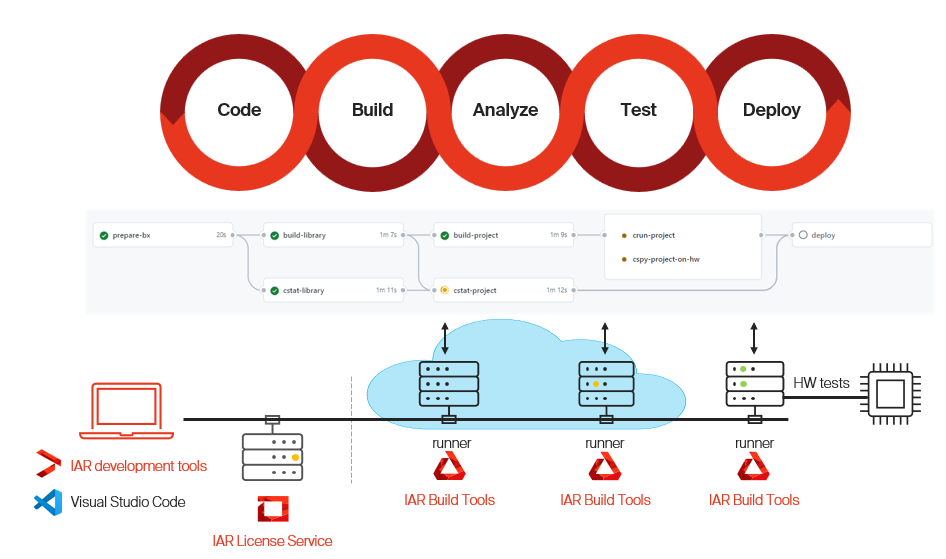
IAR's embedded CI/CD, helps teams maintain and prove determinism over time, across people, machines, and releases. This is essential when vehicle software evolves continuously while still meeting safety and compliance requirements over long lifecycles.
Industrial and IoT systems
In industrial automation and IoT, adopting an SDx mindset for codebase structure enables smoother maintenance, easier reconfiguration, and the continuous addition of new functionality through software updates. This approach allows systems to evolve over time in a controlled way, supporting optimization and new use cases without being tightly constrained by the original hardware design.
However, these systems often run continuously and cannot tolerate instability, degraded performance, or resource leakage over time. As software-defined functionality increases, failures are less likely to appear as immediate crashes and more likely to emerge as timing drift, memory fragmentation, or unintended interactions between tasks that accumulate during long system runtimes.
In this context, debugging and optimization must move beyond trial‑and‑error and isolated inspection of individual components. With IAR tools, engineers can analyze system behavior as it actually executes over time, understanding how memory is used, how timing margins evolve, and how tasks interact under real load. This system-level visibility enables identifying root causes in complex, long-running systems rather than reacting to symptoms after failures occur.
Software-defined medical devices
In medical technology, software-defined functionality enables improved diagnostics, monitoring, and treatment over time. Yet every software change must be controlled, traceable, and auditable.
In this context, certification readiness is not a milestone, it should be built into the workflow. Software evolution must preserve validated behavior while enabling improvement.
IAR supports this by making software behavior observable, repeatable, and traceable throughout development and maintenance. By enabling reproducible builds, consistent code analysis, and documented verification results, teams can demonstrate that software updates do not alter validated behavior in unintended ways. This allows device functionality to evolve while preserving regulatory confidence and protecting patient safety.
The embedded reality behind SDx
Despite its promise, SDx does not eliminate embedded constraints. Memory remains limited, real-time behavior remains mandatory, and security threats continue to evolve.
The change is in how these constraints are managed.
How IAR enables software-defined embedded systems
IAR does not dictate system architecture or business models. Instead, we provide a development foundation focused on control, repeatability, and long‑term maintainability, which are essential when embedded systems evolve through software over long lifecycles.
This foundation consists of:
Reproducible builds
With IAR Build Tools, embedded teams can integrate a certified, trusted toolchain into modern, automated build infrastructure. While determinism is a property of the overall build environment rather than the compiler alone, IAR tools are designed to behave consistently and predictably when used in controlled build workflows.
This allows teams to standardize how software is built, tested, and released across developers, CI systems, and long product lifecycles, supporting automation while preserving the traceability and documentation required in embedded and regulated environments.
Code quality and vulnerability checks are built into every build
In software-defined systems, software evolves continuously, and so must confidence in its quality.
With IAR code analysis tools, code quality is not a one-time activity, but an integrated part of the development lifecycle. Static and runtime analysis can be applied consistently in every build or release, helping teams detect defects, security weaknesses, and rule violations early.
This allows teams to:
- Enforce coding standards automatically
- Identify defects before they reach integration or production
- Check code against known vulnerability patterns
- Reduce regression risk as software evolves
By integrating code quality checks directly into the build and CI/CD workflow, every build can be analyzed, tested, and validated, ensuring that software-defined updates do not silently introduce new risks.
Performance and memory under software control
Software-defined systems still live within physical limits. IAR tools provide precise control over performance and memory usage, allowing teams to optimize for size, speed, or power as software evolves.
This helps teams avoid unnecessary hardware upgrades and keeps BOM cost under control, even as features grow.
Architecture portability without disruption
Modern embedded products must survive multiple hardware generations. IAR helps teams ensure that software architectures outlive any single processor, reducing the cost and risk of hardware changes while preserving existing software investments.
DevOps for embedded, on your terms
Embedded teams increasingly adopt automation and CI/CD, but often without the freedom to rely on public cloud services.
With IAR, DevOps for embedded is supported on your terms, not the cloud’s. Teams can automate builds and testing locally, on-premises, or in controlled environments without compromising determinism, or compliance.
SDx without losing control
Software-defined everything is not about moving fast at all costs. In embedded systems, it is about moving deliberately, predictably, and safely.
IAR enables Software-Defined Embedded Systems by turning builds, performance, and compliance into controlled, repeatable software processes, allowing teams to innovate through software without sacrificing the qualities that embedded systems depend on.
Summary
From software-defined vehicles to software-defined medical and industrial systems, the future of embedded development is increasingly shaped by software.
The real challenge is not whether systems become software-defined, but how companies retain control as software evolves over long lifecycles, across hardware generations, and amid changing regulatory requirements and growing system complexity.
The IAR Embedded Development Platform supports controlled and repeatable software evolution by providing a trusted, certified toolchain that integrates into modern embedded development workflows. By supporting reproducible builds in controlled environments, consistent code analysis, performance and memory visibility, and embedded‑focused quality and compliance mechanisms, IAR enables software‑defined innovation without undermining predictability or trust.
What’s next
With IAR, embedded teams can embrace Software-Defined Everything while maintaining the determinism and longevity that trustworthy embedded products require. Discover how IAR can support your team, or book a demo today.