Factory automation, robotics, power systems, and Industrial IoT all face the same hidden challenge: development complexity that grows faster than teams can manage.
A controller on a factory floor may run continuously for 15 years. A robotics system must synchronize multiple axes with microsecond-level precision while remaining IEC 61508-certified. A smart grid node must support a dozen protocols, accept security updates, and remain auditable long after the original team has moved on.
These are not edge cases. They define the everyday reality of industrial embedded development. And the tools teams rely on have to be worthy of that responsibility.
Where industrial programs actually slow down
Ask embedded engineers what slows their projects, and the answers are consistent. It is rarely the hardware or the application logic. The friction shows up in the development infrastructure.
Fragmented toolchains are one of the biggest sources of friction. Industrial hardware is inherently diverse: Arm, RISC-V, Renesas RX/RL78/RH850/RZ, TI MSP430, STM8, and more. Every architectural transition means rebuilding institutional knowledge and repeating qualification work that has already been done.
Safety certification compounds the problem. IEC 61508 compliance is not optional, but qualifying tools, generating evidence, and maintaining that evidence as software evolves is time-consuming and largely manual.
Protocol integration adds another layer. Industrial systems depend on deterministic communication across PROFINET, EtherCAT, Modbus, CANopen, OPC UA, and more. Finding pre-integrated, validated starting points matters enormously for project timelines.
Long-term maintainability is perhaps the most underestimated challenge. Products shipped today need to be patchable, rebuildable, and auditable in 2035. Build environments drift. Toolchain versions change. Teams turn over. Without deliberate design for long-term stability, every update becomes a risk event.
A platform designed for industrial reality
IAR's embedded development platform was built around the constraints that define industrial automation: long lifecycles, strict safety requirements, diverse hardware, and the need for deterministic behavior across every layer of the stack.
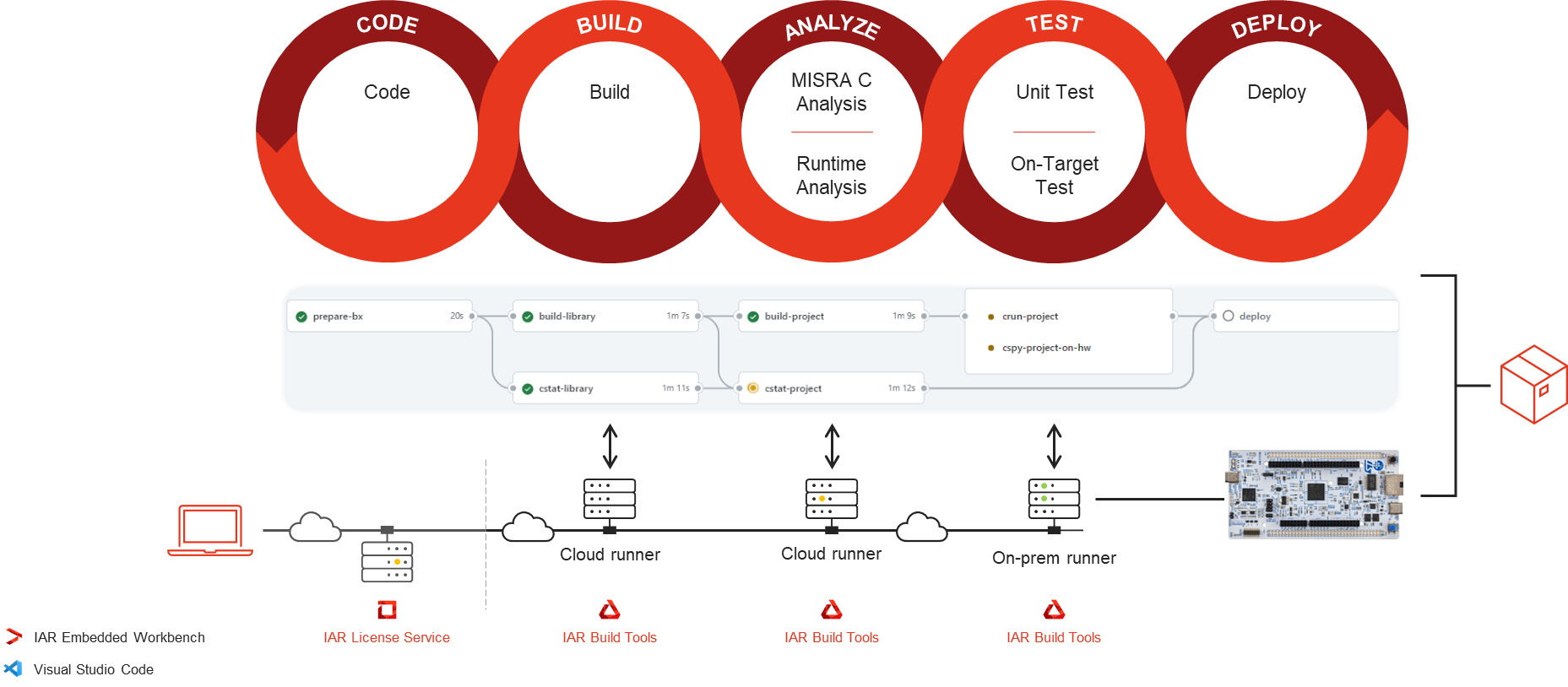
Image: IAR in agile workflows
Safety certification without the overhead
IAR's toolchains are TÜV SÜD-certified for IEC 61508, classified as T3 tools suitable for any Safety Integrity Level. That means pre-validated compilers and build tools with published Safety Manuals and certificates, reducing the qualification burden directly rather than shifting it to the development team. Certified packages are available for ST STM32, Renesas RA, RX, and RH850 families, NXP, and others, so the same approach scales across a diverse device portfolio without having to rebuild evidence from scratch.
Architecture flexibility within a consistent workflow
The IAR Platform supports more than 20 architectures, Arm, RISC-V, Renesas RL78/RX/RH850, STM8, and more within a single, consistent toolchain. Teams working across device families from NXP, Infineon, TI, Renesas, and ST do not need to fragment their development environments or their compliance processes. One certified foundation, any hardware.
Communication stacks that run right
IAR's highly optimizing compiler ensures that industrial protocol stacks execute with tight timing, small memory footprints, and predictable behavior. The platform is validated with commercial stack partners, including port GmbH, rt-labs, Hilscher, and Softing, as well as open-source stacks such as SOES (EtherCAT), p-net (PROFINET), and open62541 (OPC UA). Semiconductor SDKs from TI, Renesas, and NXP are integrated and validated, so teams start from a trusted baseline rather than assembling stacks from scratch.
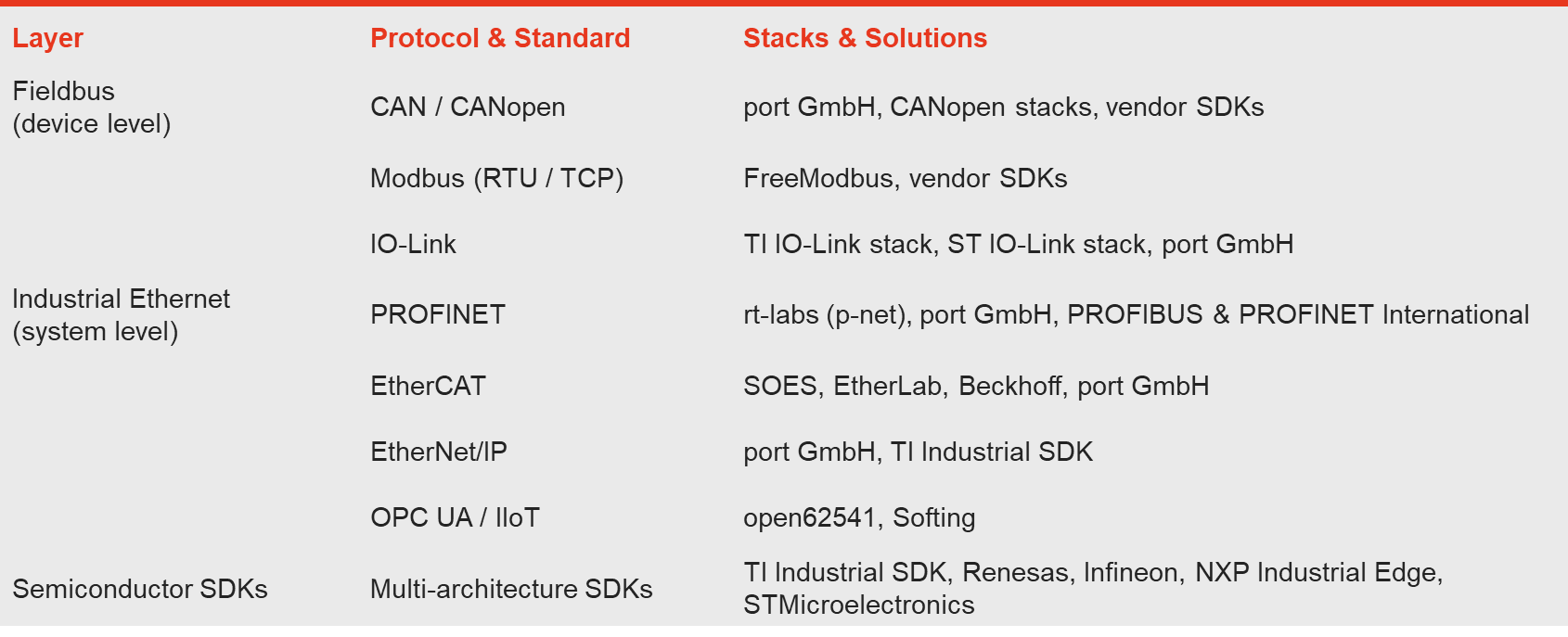
Image: Industrial communication stacks & ecosystems supported by IAR
DevOps-ready from day one
IAR toolchains run natively in containers and integrate with Jenkins, GitHub, GitLab, and Kubernetes. Reproducible builds and scalable CI/CD pipelines are not nice-to-have, they are built into how the platform works. For teams managing distributed development across sites or maintaining firmware for a large installed base, this consistency is foundational.
Security is built into the development process
The EU Cyber Resilience Act and evolving IEC standards are raising the global security baseline for industrial products. IAR's embedded security features, secure boot, firmware signing, encrypted code, and runtime integrity checks are part of the same platform as the compiler and debugger. There is no separate security layer to qualify, maintain, or integrate independently.
Long-Term Support Services
For products with ten to twenty-year field lifetimes, toolchain stability is a strategic requirement. IAR's Long-Term Support Services maintain validated, reproducible build environments across extended product lifecycles, enabling firmware rebuilds, field issue investigations, and updates without re-qualifying the entire toolchain. This is what makes long-lived industrial software maintainable in practice.
What teams are seeing in practice
The bottlenecks described above are not theoretical. Here is how three industrial automation leaders resolved these issues using the IAR toolchains.
- Panasonic Electric Works: CI/CD integration across long-lifecycle automation product lines, without disrupting existing workflows
- Landis+Gyr: Earlier defect detection with C-STAT static analysis, reducing rework across a wide MCU portfolio
- Schneider Electric: Reduced development time through state-machine modeling and automatic code generation
What this means for your next project
Whether you are designing a new robotics platform, maintaining a fleet of industrial controllers, or preparing for the Cyber Resilience Act, the challenges compound in the same direction: fragmented tools, certification overhead, protocol complexity, and decades of product maintenance.

Image: From code-creation to the assembly line
IAR addresses these with a unified, safety-certified foundation that scales from a single MCU to a multi-architecture product family, and from first build to the last firmware update two decades later.
What’s next?
Explore the IAR industrial automation solutions to see the full platform in context . And if you want to go deeper into how an IEC 61508-certified foundation removes the bottlenecks that slow Smart Industry initiatives, watch the webinar “Breaking the smart industry bottleneck”.